
Pre Training Requirements General
Rope Access requires those engaged in the work to have an appropriate attitude and aptitude to safety, in addition to a good level of fitness and physical capability. If unsure, an appraisal session should be arranged with an IRATA International trainer member company.
An aptitude for working at height includes not only having ‘a head for heights’, but also an appropriate level of responsibility and self-reliance. A healthy respect for heights remains an advantage; over-confident or reckless workers may present greater risks than the cautious.
Rope access work locations are often remote. It is therefore important that operatives can be relied upon to behave in a sensible and responsible manner.
The trainer member company has the right to exclude any candidate from training if they have concerns over the candidate’s health, fitness, and/or attitude to safety during training.
Candidates shall be at least 18 years of age at the start of the course and must not exceed a weight limit of 130 kg. Candidates are required to certify that they do not have any medical disabilities or contraindications that may prevent them from working safely.
Principal contra-indications to working at height include (but are not limited to):
- Prescribed medication that may impair physical and/or mental function;
- Alcohol or drug dependence;
- Diabetes, high or low blood pressure;
- High or low blood pressure;
- Epilepsy, fits or periods of unconsciousness, eg. blackouts;
- Vertigo, giddiness or difficulty with balance;
- Heart disease or chest pain;
- Impaired limb function;
- Musculoskeletal issues, e.g. back pain;
- Psychiatric illness;
- Fear of heights;
- Sensory impairment e.g. blind, deaf.
Pre-training requirements: upgrading to Levels 2 or 3.
Candidates applying to upgrade shall be competent in all practical and theory requirements of their current level prior to attendance of an upgrade course. E.g. an existing Level 1 attending a Level 2 course shall be capable of performing all Level 1 techniques and answering Level 1 theory questions prior to the start of a Level 2 course.
Candidates who are not competent at their existing level may require additional training. As little time is available on upgrade courses for refresher training, pre-course evaluation is recommended to verify the candidates’ current level of competence.
Candidates seeking to upgrade shall ensure that:
- Their current certification is still valid on the day of assessment;
- They have the necessary 12 months experience and 1000 working hours recorded and signed in their logbook.
Rope access technicians who are upgrading or revalidating shall provide their logbooks to the IRATA International trainer member company at the start of the training course. Where rope access technicians have lost their logbooks, they shall arrange for a replacement to be issued, completed and verified before assessment.
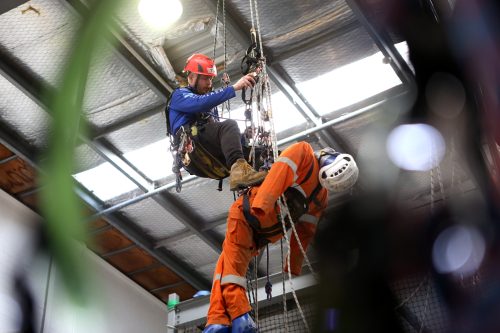
IRATA International’s Rope Access system is a safe method of working at height where ropes and associated equipment are used to gain access to and from the workplace and be suspended at the worksite for the duration of the work.
The advantage of using Rope Access methods lies in the safety and efficiency with which workers can get to or from difficult locations to carry out their work, often with minimal impact on plant operations. The success of IRATA’s method of rope access is based on thorough training and strict work guidelines that deliver an unrivalled safety record year after year.
The Industrial Rope Access Trade Association (IRATA International) includes within its membership, operating companies, training companies and technicians. Technicians are those who have learned their skills from the training companies of the Association. The teaching of the IRATA syllabus enables Rope Access technicians to progress through three levels of proficiency, with certification issued at each level. The IRATA technician carries a card that is recognised globally for its importance and value; over 150,000 IRATA technicians have been registered with over 500 member companies and in every continent. The thorough, IRATA training program delivers a skilled workforce that can reliably deliver work-at-height methodologies.
IRATA Instructors are specialists and experts in their field who have theoretical and practical teaching skills. Their individual abilities and the training facilities where they work are regularly and independently assessed to ensure that training is being delivered to the highest global standards.
IRATA Training Scheme Flowchart
LEVEL 1
Pre-requisites
- No previous experience required.
- Aptitude for working at heights.
- Physically and medically fit.
- Minimum age of 18 years.
Training Scheme
- 5-Day training course in rope access.
- Independent IRATA assessment.
Capabilities
- Basic Technician.
- Capable of performing a range of activities under the supervision of a Level 3.
- Responsible for their own personal rope access equipment.
LEVEL 2
Pre-requisites
- Minimum 12 months and 1000 hours of work experience in a variety of tasks as a level 1 rope access technician.
- Physically and medically fit.
Training Scheme
- 5-day training course in rope access, rigging & rescue.
- Independent IRATA assessment.
Capabilities
- Rope Access Technician.
- Capable of rigging ropes and undertaking rescues, including hauling, under supervision of a level 3 rope access technician.
LEVEL 3
Pre-requisites
- Minimum 12 months and 1000 hours of work experience as a level 2 rope access technician.
- Appropriate first aid certificate.
- Physically and medically fit.
Training Scheme
- 5-day training course in advanced rope access techniques, rescue, equipment examination & legislation.
- Independent IRATA assessment.
Capabilities
- Rope Access Technician (Supervisor).
- Capable of site supervision for rope access work projects. Comprehensive knowledge of advanced rescue techniques.
- Conversant with relevant work techniques & legislation.